
Everest Records & Statistics: Summits, Deaths & Superlatives
Total Summits & Climbers
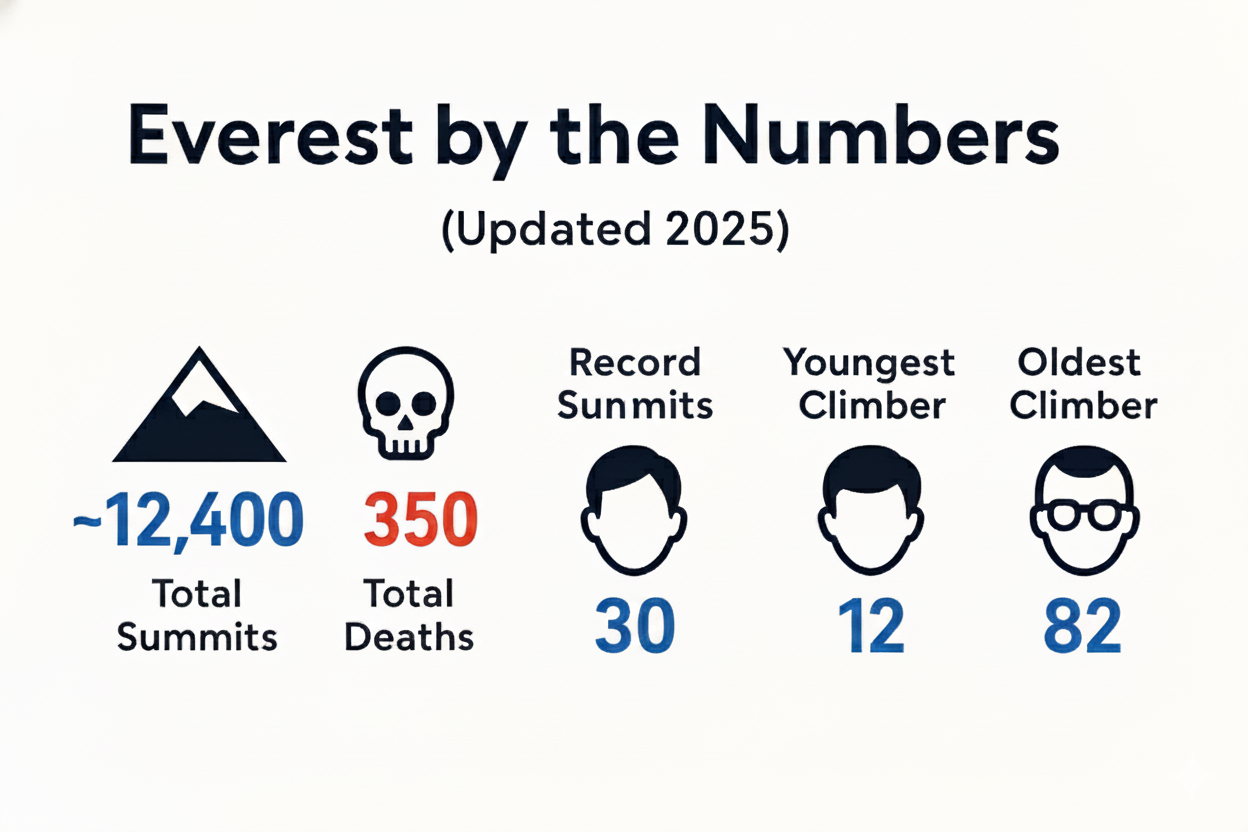
Since the first successful ascent in 1953, more than 12,000 climbers have reached the summit of Mount Everest, according to the Himalayan Database Everest 2025. The number continues to rise each year, setting new Mount Everest summit records and defining the mountain’s legacy as a living archive of human endurance.
Each climbing season adds new names to the list of Everest achievement records, as success rates rise due to improved weather data, route fixing, and professional Sherpa teams. The 2025 season saw record participation — with more than 900 climbers attempting the summit — a figure reflected in the latest Mount Everest records update.
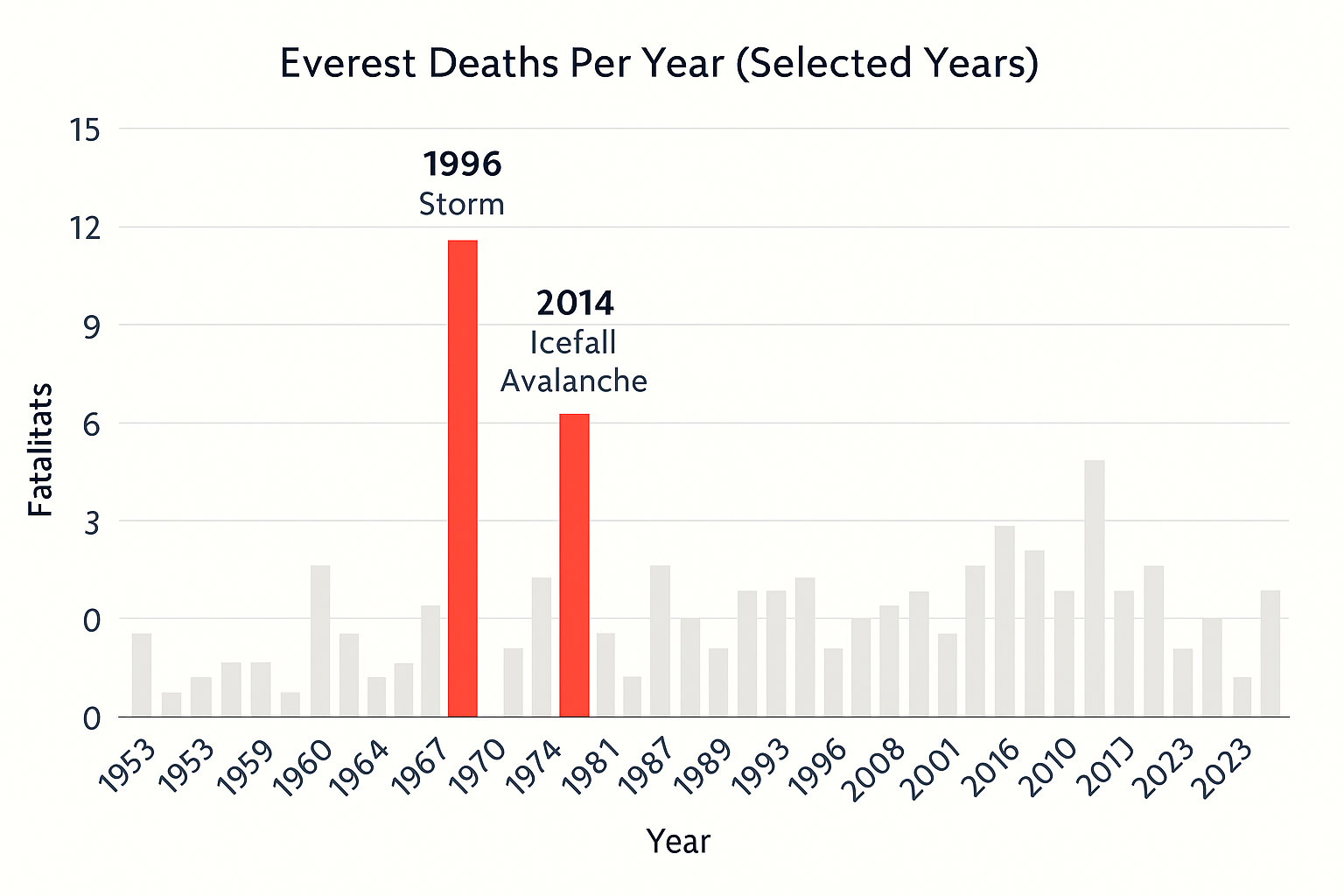
According to official sources, more than 330 people have lost their lives on the mountain since records began. This number includes notable years such as 1996 and 2014, which remain benchmarks in Everest deaths statistics and mount everest climbing history records.
By comparison, total successful ascents in the 1950s numbered less than 20, while today the mountain sees over 600 summits per year — an exponential rise documented in Everest summit statistics 2025.
This increase is due to better weather forecasting, improved equipment, and the extensive logistical support provided by commercial expeditions. For a detailed breakdown, see our page on Everest summit statistics.
Firsts & Pioneers
Mount Everest has been the stage for humanity’s boldest “firsts.” These historic moments not only shaped mountaineering but also created many of the Mount Everest world records still honored today. Each of these milestones remains part of the official Everest records list and continues to inspire future climbers.
Certain records are immutable—they can only be set once. These “firsts” mark pivotal moments in the history of Everest and mountaineering itself.
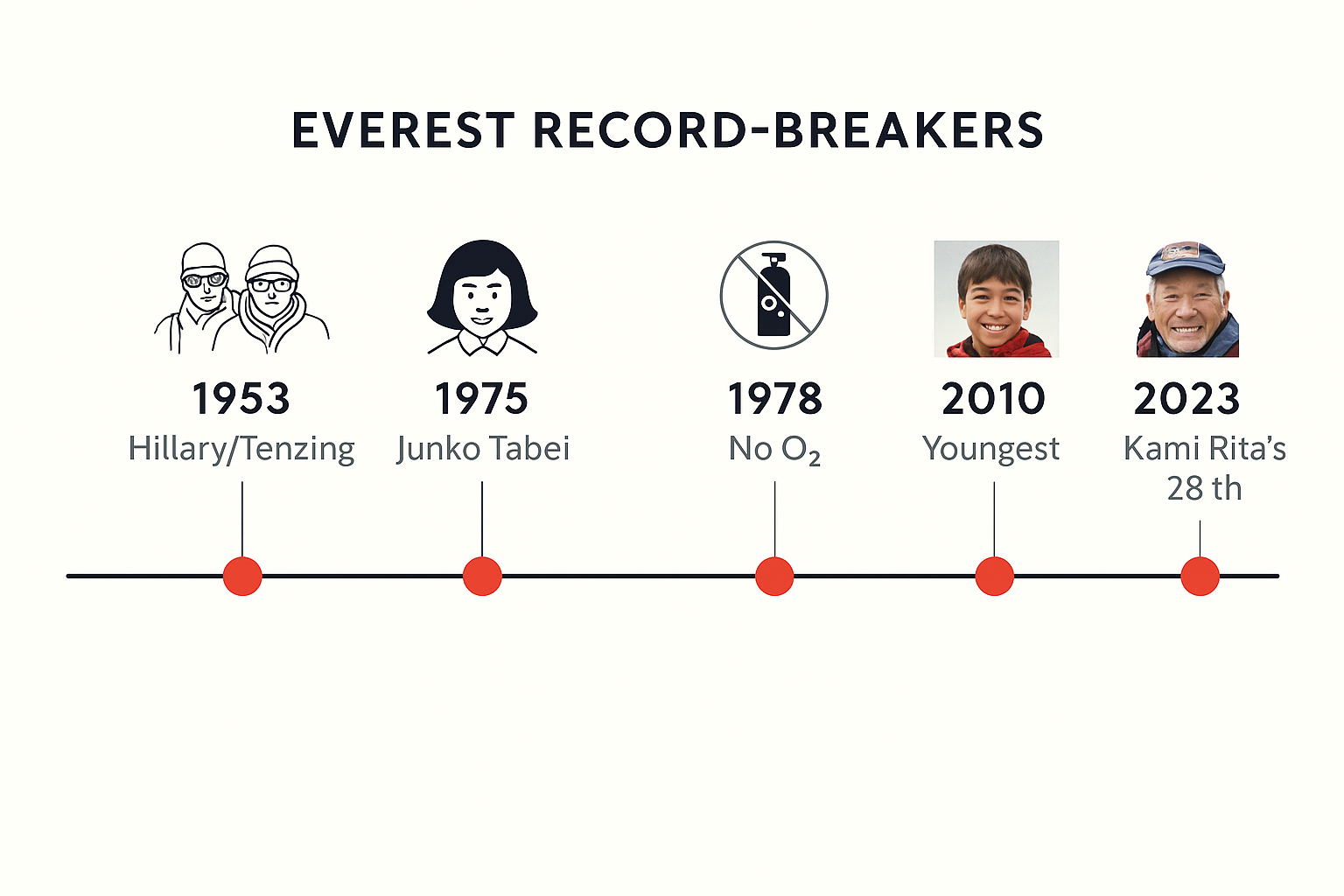
- First successful ascent: Sir Edmund Hillary (New Zealand) & Tenzing Norgay (Nepal) – 1953
- First woman to climb Mount Everest: Junko Tabei (Japan) – 1975. A pioneer in both gender equality and endurance sports, her climb stands as one of the most iconic female Mount Everest records recognized by Guinness World Records Mount Everest.
- First ascent without supplemental oxygen Reinhold Messner (Italy) & Peter Habeler (Austria) – 1978. This achievement shattered beliefs about human limits and remains one of the defining Mount Everest climbing records in history.
- First winter ascent: Leszek Cichy & Krzysztof Wielicki (Poland) – 1980. The pair achieved this at –40 °C with hurricane-force winds, a feat still celebrated in Everest historical records.
- First blind climber: Erik Weihenmayer (USA) – 2001 – first to summit Everest without sight, part of modern Mount Everest achievement records.
- First double amputee climber: Mark Inglis (New Zealand) – 2006 – proved Everest’s spirit transcends physical limits.
- First father and son to summit together: Yuichiro & Gota Miura (Japan) – 2003.
These achievements redefined what was considered possible and paved the way for future generations of climbers. Discover more at our page on Everest’s pioneering ascents.
Youngest & Oldest Climbers
The records for age demonstrate the incredible range of human capability, from youthful determination to lifelong passion.
- Youngest Everest Climber: The youngest person ever to summit Mount Everest is Jordan Romero (USA), who reached the top in 2010 at just 13 years old. His climb remains one of the most inspirational Mount Everest climbing records and a highlight in the list of Mount Everest world records.
- Oldest Everest Climber: The oldest climber to reach the summit is Yuichiro Miura (Japan), aged 80 in 2013 — a record officially recognized by Guinness World Records Everest. His achievement exemplifies that age is no barrier to ambition and stands as one of the most remarkable Mount Everest world records of all time.
- Youngest Female Climber: Malavath Purna (India), age 13 years 11 months – 2014 – an enduring entry in female Mount Everest record holders.
- Oldest Woman to Summit Everest: Tamae Watanabe (Japan), age 73 – 2012.
- Record for Most Summits by a Single Climber: Kami Rita Sherpa, who completed his 29th ascent in 2025, setting a new Mount Everest record breaker 2025 milestone.
Over 70 climbers aged under 18 have reached the summit since 2010, while dozens of seniors over 70 continue to attempt it — a sign of how Everest records by age and generation keep evolving in the modern era.
Most Summits by Individuals
For many climbers, Mount Everest is not just a single triumph but a lifelong vocation. The record for the most summits of Mount Everest belongs to Kami Rita Sherpa, who has now stood on the top 29 times as of 2025, according to the Nepal Everest Summit Official Report 2025. This feat cements his place in Mount Everest world records and the Guinness World Records Mount Everest database.
The following chart lists some of the most prolific Everest summiteers, illustrating a proud legacy of Sherpa Everest records that continues to expand every year.
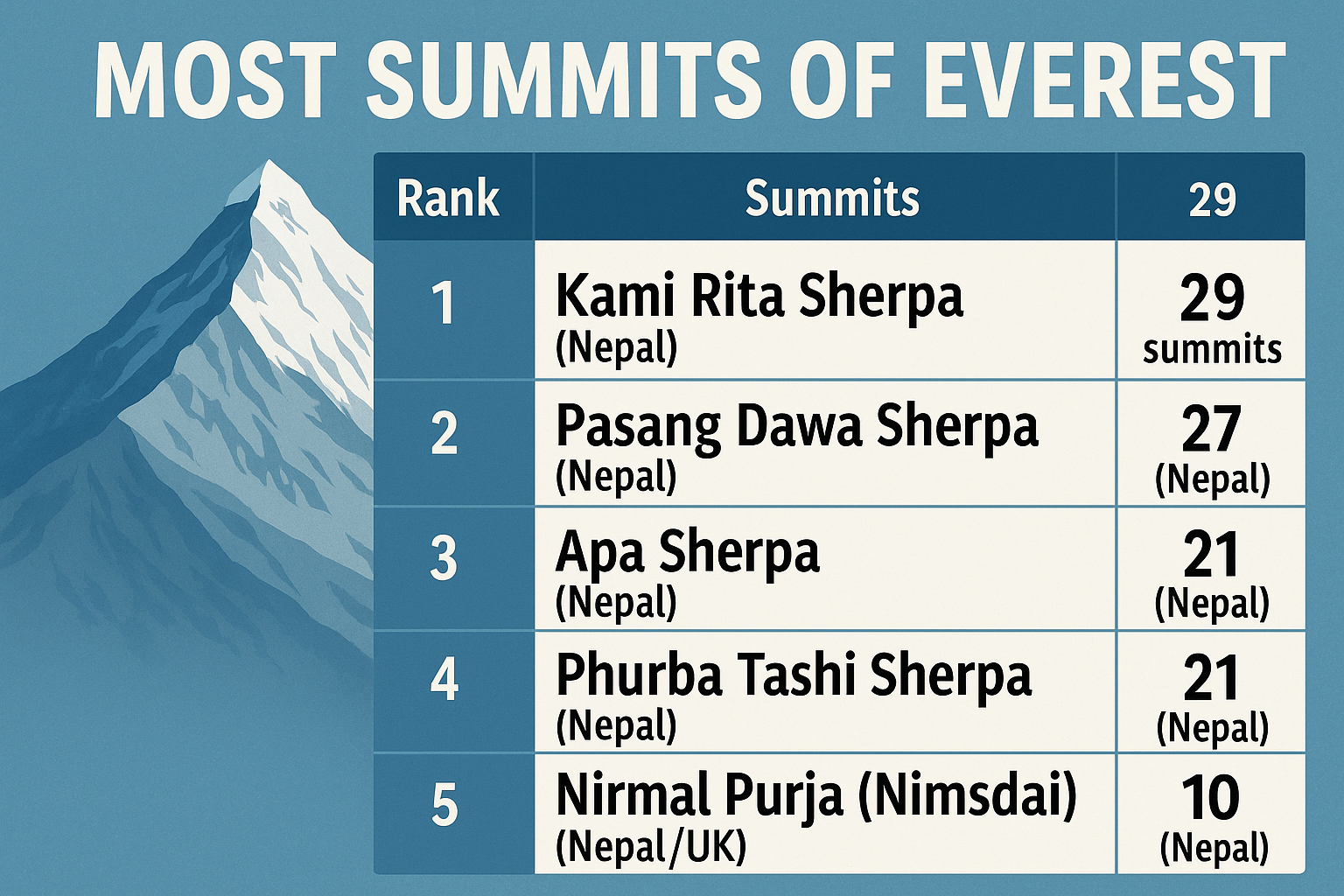
The leaderboard for the most successful summits of Mount Everest is led by Nepali guides.
- Kami Rita Sherpa (Nepal): The undisputed “Everest Man,” Kami Rita holds the all-time record. As of 2023, he has successfully summited an incredible 28 times and continues his career as a senior guide. His record is a testament to the central role of the Sherpa culture in Himalayan climbing.
- Apa Sherpa (Nepal): Held the record for many years and was the first person to reach 21 summits before retiring in 2011.
- Pasang Dawa Sherpa (Nepal): Reached his 27th summit in 2023, making him the second person to hold such a high number of ascents.
Behind him are a generation of Sherpa climbers whose dedication has shaped Everest climbing records for decades. Many, such as Pasang Dawa Sherpa (27 ascents) and Apa Sherpa (21 ascents), are featured in the Everest record holders list for their remarkable endurance and service.
Kami Rita’s record illustrates the Sherpas’ unmatched contribution to Everest history. Collectively, Sherpas now hold over 80% of all Mount Everest summit records, according to the Himalayan Database Everest 2025. Their accomplishments are considered national treasures of Nepal and key milestones in Mount Everest climbing history records.
Speed Records
The fastest Mount Everest ascent record is held by Lhakpa Gelu Sherpa, who reached the summit from Base Camp in just 10 hours and 56 minutes (2003). This astonishing feat remains in the list of Mount Everest world records and has been recognized by Guinness World Records Everest for over two decades.
Other Sherpa climbers, including Pemba Dorje Sherpa, have attempted to break this record, though verification disputes have kept Lhakpa Gelu’s time as the official benchmark in Everest climbing records. However, new athletes continue to push limits each year — including Nirmal Purja (Nimsdai), who completed three Everest summits in one season (2019), a feat recognized in the Mount Everest record breaker 2025 list.
Endurance & Alternate Records:
- Longest stay on Everest summit: Babu Chiri Sherpa – 21 hours (1999)
- Fastest double ascent: Kami Rita Sherpa – two summits within one week (2023)
- Fastest female ascent: Lhakpa Sherpa (Nepal) – 2022
- Fastest ascent without oxygen: Kilian Jornet (Spain) – 26 hours (2017, from Tibet)
These remarkable achievements showcase both speed and survival skill, forming the foundation of modern Mount Everest achievement records.
With GPS and timing validation now standardized, future speed challenges will continue to evolve. The latest Mount Everest records 2025 update suggests that smart-wear tracking and drone monitoring may soon make every record instantly verifiable.
Deaths & Fatality Statistics
Despite advances in safety and logistics, Mount Everest continues to claim lives each year. Each season’s Everest deaths statistics reveal the extreme risks of climbing above 8,000 meters, where oxygen deprivation, exhaustion, and exposure remain constant threats. These tragedies are documented in the Himalayan Database Everest and reflected in updated Mount Everest records 2025.
- Total Fatalities: over 330 climbers since 1953 (updated 2025). These figures are drawn from verified Everest climbing statistics and include the most recent losses from the 2023–2024 seasons.
- Modern Fatality Rate: The overall death rate has fallen significantly. In the modern commercial era, the rate is approximately 1% of all climbers who attempt the mountain. This means for every 100 climbers, one will die.
- Deadliest Year: 1996 – 15 deaths during a catastrophic blizzard that inspired the book Into Thin Air.
- Second deadliest event: 2014 – avalanche in the Khumbu Icefall killing 16 Sherpas.
- Average fatality rate approximately 1% per year, a slight decline due to modern forecasting and oxygen management. Despite this, overcrowding and climate change have led to a rise in non-accident-related deaths (exhaustion, illness), a trend noted in Everest fatalities 2025.
- Most deaths in one season 4 confirmed deaths, marking one of the safest seasons in a decade.
- Most recent season (2025)placeholder
- Total bodies remaining unrecovered approximately 200, many preserved by ice and visible on standard routes.
While grim, these numbers remind climbers of the mountain’s dual identity: achievement and risk intertwined. The Mount Everest deaths record continues to evolve, reflecting both human courage and nature’s power.
Summits by Country
Mount Everest now draws climbers from over 100 nations, making it the most international endeavor in modern mountaineering. Each year’s Everest summit statistics highlight new Everest records by country, showcasing global participation in the quest for the top of the world.
The largest numbers of climbers still come from Nepal, China, the United States, and India. These nations dominate the Everest summit records list, both in volume and milestone achievements.
- Nepal: over 6,500 successful ascents (as of Mount Everest records 2025 update). Nepalese climbers — especially Sherpas — hold the majority of Everest climbing records worldwide.
- China: more than 1,400 summits, including new Everest record holders on the north route via Tibet.
- United States: 850+ successful summits (updated 2025), including record-setting climbs by female Mount Everest record holders such as Melissa Arnot Reid.
- India: 450+ total summits, featuring several unique national milestones — including Premlata Agarwal, the first Indian woman to complete the Seven Summits.
- Japan: 500+ summits – home to both the oldest male (Yuichiro Miura) and oldest female (Tamae Watanabe) Mount Everest record holders.
- UK: 300+ summits – including Kenton Cool, who has climbed 17 times.
- Pakistan: 200+ summits – increasing rapidly in the last five years.
- Poland: notable for early Everest winter ascent records.
Together, these nations form a growing database of Everest records by nationality, proving that the challenge of Everest transcends borders. The Everest summit statistics 2025 confirm a new milestone: 12,500+ total successful summits globally since 1953.
Key Takeaways
Mount Everest is more than just Earth’s highest mountain — it’s a living archive of human endurance, courage, and innovation. Every line in the Mount Everest records tells a story: from the first ascent in 1953 to the latest Everest record breakers, each chapter reveals how humanity keeps pushing boundaries.
The statistics may shift with every climbing season, but the spirit remains timeless: Everest is where ordinary people achieve the extraordinary. As the Mount Everest world records list expands each year, so does our understanding of determination, teamwork, and resilience.
These achievements remind us that every Mount Everest climbing record is earned through patience, courage, and reverence for the mountain. The data behind the Everest summit statistics 2025 isn’t just numbers — it’s human life translated into endurance, tragedy, and triumph.
What are the Key Insights so far?
- Total summits surpassed 12,500+
- Kami Rita Sherpa’s 29th summit set a new high-water mark in Everest climbing records
- Sherpas now hold over 80% of all recorded summits
- Yuichiro Miura’s record (80 years) remains unbroken
- Female participation and female Mount Everest record holders continue to rise annually
Together, these achievements define the ongoing evolution of Mount Everest records and statistics.
Frequently Asked Questions About Mount Everest Records (2026 Update)
Who was the first person to climb Mount Everest?
Sir Edmund Hillary (New Zealand) and Tenzing Norgay (Nepal) reached the summit on May 29, 1953, creating the foundation of modern Mount Everest climbing history records.
Who has climbed Mount Everest the most times?
Kami Rita Sherpa of Nepal holds the record with 29 summits as of 2025, according to Guinness World Records Mount Everest. He continues to extend his legacy each year, redefining Everest summit records.
Who is the youngest person to climb Mount Everest?
Jordan Romero (USA), age 13, reached the summit in 2010, still holding the official youngest climber record recognized by the Himalayan Database Everest.
Who is the oldest person to climb Mount Everest?
Yuichiro Miura (Japan) summited at 80 years old in 2013, a feat recorded in Guinness World Records Everest.
What is the fastest time to climb Mount Everest?
Lhakpa Gelu Sherpa (Nepal) reached the summit in 10 hours 56 minutes from Base Camp (2003). This remains one of the most celebrated Mount Everest climbing records for speed.
How many people have climbed Mount Everest?
Over 12,500 climbers have reached the summit as of Mount Everest records 2025 update, according to the Nepal Department of Tourism.
Where can I find official Everest statistics and records?
The most accurate and continuously updated sources include:
- The Himalayan Database (HDB)
- Guinness World Records Mount Everest
- Alan Arnette Everest Summit Statistics 2025
- Nepal Everest Summit Official Report 2025
These are the authoritative references for Everest record holders list and climbing data verification.
Whether you’re an aspiring climber, researcher, or enthusiast, these sources ensure that the latest Mount Everest world records are always within reach — documenting every ascent, record, and milestone as history continues to unfold.
Daniel Whitaker is a mountain journalist and lifelong climber with over 15 years of experience in the European Alps and the Andes. Although he has not yet attempted Mount Everest, he has summited several 6,000-meter peaks in South America and multiple classic alpine routes in the Mont Blanc massif. Daniel specializes in writing about the culture, history, and psychology of mountaineering. His work combines first-hand mountaineering experience with extensive research on Himalayan expeditions, making him an engaging guide to Everest’s enduring myths, records, and inspirational quotes.